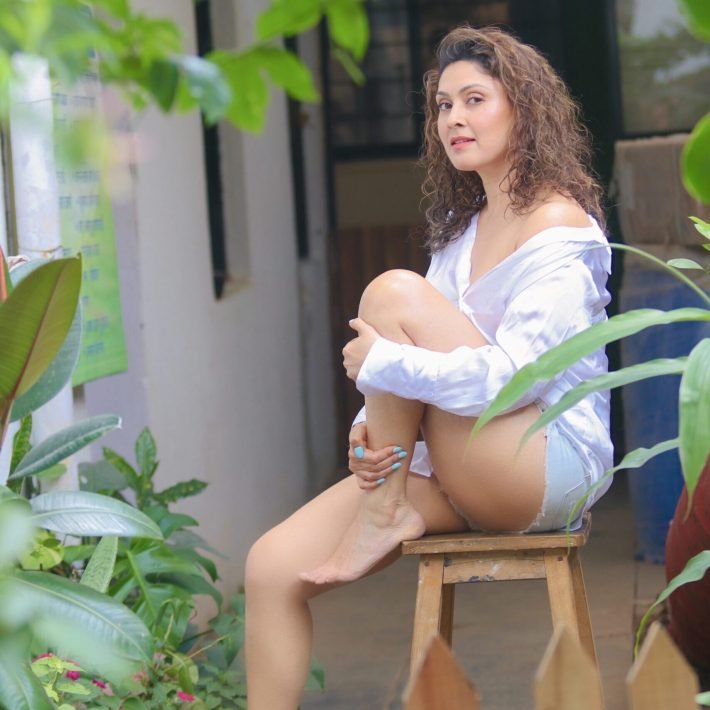

A leading light of Bengali cinema who has also charmed Hindi audiences, Rituparna Sengupta – actor, dancer, producer and mother – has embraced every role with grace. She opens up about her journey, and why meaningful storytelling remains her true calling.
By Andrea CostaBir
Contributions by Priyanjana Nandi
Rituparna, your journey from ‘Dahan’ to ‘The Parcel’, ‘Paromitar Ek Din’ to ‘Ahaa Re’, has been extraordinary. How do you personally measure growth — as an actor and as a woman navigating different phases of life and cinema?
My journey has been wondrous, enigmatic and deeply enriching. Over the years, my experiences have endured much wear and tear. It has been a remarkable path, at times one part of me stumbled, but another part lifted me up, steadied my uncertain self, and set me back to work. I never allowed circumstances to halt my efforts.

As a woman, I feel completely absorbed in this craft. Womanhood itself gained new meaning through this profession, where I brought to life so many female characters, women who held immense significance for their families and for society. I feel proud to have given shape to those stories.
My journey through cinema has been the most fulfilling chapter of my life. Even during pregnancy, I continued working until a certain stage, undeterred in spirit. To this day, I remain energised by the anticipation of what my next role will be. My growth as an actor has been gradual, unfolding with each film. I could sense the changes within me, evolving from project to project. The recognition of audiences, together with the unwavering confidence of directors and producers, constantly instilled fresh hope and inspired me to create anew.

I have always believed in positivity and hard work, and that remains my guiding mantra.
You’ve balanced commercial blockbusters with nuanced, award-winning roles. Was this duality a conscious career strategy?
As an actor, I have always felt a strong need to present and perform every kind of role with élan and conviction. The shift in my career came about very subtly, and I surrendered to the flow with ease. From commercial potboilers to the works of Rituparno Ghosh, Aparna Sen, Buddhadeb Dasgupta, Priyadarshan, and Tarun Majumdar, each step has deepened my connection with cinema.

Although I am an outsider and very much a product of commercial cinema, I now find myself fully immersed in cinema in all its forms. I feel truly blessed to have remained in this craft for so many years. The love people have showered upon me has been overwhelming; ‘Puratawn’ stands as a shining example, when I had the privilege of working alongside the legendary Sharmila Tagore.
Working with directors like Rituparno Ghosh, Aparna Sen, and Buddhadeb Dasgupta must have left an imprint. What has each of them taught you — about cinema or about yourself?
Aparna Sen, Rituparno Ghosh and Buddhadeb Dasgupta – legends in their own right – shaped my career in lasting ways.
Aparna Sen taught me to inhabit characters deeply, like Paromita, a mother navigating the challenges of raising a special child. She also introduced me to the workshop culture – preparing and exploring a role before the shoot – a method that transformed my approach to acting.

Rituda was like a father. We lived close by, often shared breakfast, and spoke about life as much as cinema. He never missed my birthday; and on my wedding day, he dressed me, wrote poems for my invitation card, and painted chandan on my face to match my Benarasi sari. We laughed about the mix-ups our shared name often caused. Losing him was a personal and professional loss. ‘Dahan’ and ‘Utsab’ remain milestones in my journey with him.
Buddhadeb Dasgupta was a perfectionist, defined by discipline and his mastery of natural light. I was fortunate to work with him on ‘Mondo Meyer Upakhyan’, which won the National Award for Best Film. I regret missing ‘Uttara’ due to date clashes, but years later, I worked with his daughter, Alokananda Dasgupta, now a noted music composer, on ‘Puratawn’ with Sharmila Tagore – an especially meaningful reunion, as Alokananda and I were schoolmates.
You’ve also charmed the Hindi audience with films like ‘Main, Meri Patni Aur Woh’ and ‘Bansuri: The Flute’. Do you feel the Hindi film space has fully tapped into your potential yet?
I had a fantastic start, working alongside Mithun Chakraborty, Gautami, Chunky Panday, and Amol Palekar. It was quite an exquisite debut. Soon after, I became occupied with a few Bengali films, before starring in ‘Main, Meri Patni Aur Woh’. That film was ahead of its time, yet it resonated deeply with audiences. It featured an eclectic cast, including Kay Kay Menon, Rajpal Yadav, and several accomplished theatre actors.

I went on to do films such as ‘Bum Bum Bole’ with Priyadarshanji and ‘Dil Toh Baccha Hai Ji’ with Madhur Bhandarkarji. Another film, ‘Bansuri’, with Anurag Kashyap and me, had only a brief release due to the pandemic.
Although my career in Mumbai has not been flawless, I have continued to work steadily in a number of films, including niche projects such as ‘Life Express’, which explored the subject of surrogacy. I am also awaiting the release of ‘Ittar’, in which I star opposite Deepak Tijori. I truly wish to work more in the Hindi film industry, especially with directors who create meaningful cinema.

Beyond the screen, you’re a dancer, producer, wife, mother, and an advocate for meaningful storytelling. How do you navigate all these identities? Do give us an insight into your personal and professional life.
I juggle several roles — actor, producer, social ambassador for certain causes, dancer, and, of course, a family person. Life is short, and I like to immerse myself in its many facets. I want to explore different arenas and leave an imprint as I journey through them.

I have been dancing since childhood, and performing before the camera never daunted me. I believe one’s professional and personal life must be balanced with careful measure. For women, this is often more difficult, but also we are naturally wired to take on greater responsibilities. As a mother with a demanding profession, I feel fully invested in everything I do.

Yes, it is hard work with my family and I being in different countries. But I draw strength from a generational lesson: To devote myself wholeheartedly both to caring for others and to my work. So far, it has kept me going strong.
In recent years, your film choices — from ‘Ahaa Re’ to ‘The Parcel’ — show a strong pull towards personal, emotionally rich narratives. What kind of stories speak to you at this stage in your life and career?
As an actor, I am motivated by the possibilities each role presents. Whenever I take on a story, I ask myself how much of a statement I can make through the character. When I did ‘Ahaa Re’, it explored two countries and two people from different religions, with food becoming the bond that united them. More recently, ‘Puratawn’, featuring Sharmila Tagore after a 14-year hiatus, created a moment of significance for Bengali cinema audiences – though our cinema, since the days of Satyajit Ray, has always enjoyed a global reach.

I believe films must connect with their audience. With the advent of OTT platforms and increasing accessibility, language is no longer a barrier. I value both larger-than-life films and those that delve into intricate, layered issues. With my team, I strive to put forward meaningful content – and more than ever, I feel drawn towards strong, thoughtful storytelling.

Having portrayed so many layered female characters, how do you see the evolution of women’s representation in Indian cinema?
I feel optimistic about the position of women in cinema, as both have evolved significantly over the years. Women have always had a presence in film, but today they are far more conscious of the kind of content they choose to be part of. Remarkable films are now being made about women.

There have always been women’s voices in cinema, even if faint, but now those voices are clearer and more confident, as seen in films such as ‘Rajkahini’, and ‘Laapataa Ladies’. Society itself has acted as a catalyst, encouraging women to speak for themselves – and cinema has become a powerful medium for that expression.
Looking ahead, when someone says “Rituparna Sengupta” – what would you like to be remembered for?

That is such a wonderful question. I truly believe Rituparna Sengupta should be remembered through her characters – whether it is Paromita in ‘Paromitar Ek Din’, Begum Jaan in ‘Rajkahini’, or Sudipa in ‘Prakton’. I would like to be remembered with fondness and to have influenced people through my cinema.I am deeply grateful to my audience for the generosity with which they have embraced my work. More than anything, I wish to be remembered as a good human being – for my human qualities will always matter above all else. If I am able to touch hearts, I will feel content.