
Akshay Chavan, author of ‘The Wealth Networks’, offers a fresh perspective on Indian history by tracing the connections between people, places and prosperity, says Nichola Marie.
Your book presents Indian history through the networks of roads, rivers and seas that carried wealth, people and ideas. What sparked this way of thinking, and how did it alter the way you saw well-known historical events?
My love of history has taken me to some of the remotest monuments, forts, temples and archaeological sites across India. Whenever I travel, I have a habit of looking out of the window and observing the landscape, like the rivers, mountain ranges, and fields. Over time, I began to notice patterns. The question that changed everything for me was simple: Why is this place located here and not somewhere else? Why was this fort built on this hill? Why did this city flourish in this valley? The answers were almost always geographical and economical. Once I started looking at India through that lens, many familiar historical events began to make sense in entirely new ways.
‘The Wealth Networks’ revisits familiar historical questions through geography and commerce. Which discovery or historical connection surprised you the most during your research?
During my research, there were many moments when I found myself thinking, “Of course — that makes perfect sense.” One of my favourites was discovering why the British were so determined to annex Jhansi. Every Indian knows the story of Rani Lakshmibai’s heroic resistance during the Revolt of 1857, but few ask why Jhansi mattered so much to the British.

The answer went far beyond territorial expansion. It was tied to the Industrial Revolution, global trade networks, and the movement of raw materials across the Empire. Seeing that connection transformed a familiar story and revealed how much remains hidden beneath the surface of history.
Do you believe the forces that shaped historical India continue to influence economic and political power today?
Absolutely. The fact is, geography never stopped shaping history, it is just that we simply stopped paying attention to it.
Take the Strait of Hormuz. Today, it is in the headlines because of its impact on global energy markets and international politics. Yet for centuries, Hormuz was deeply connected to India. In the medieval period, it formed a vital network with ports along India’s western coast, from Gujarat to Kerala. Even the Parsis spent years there before arriving in India. So when the recent crisis unfolded, it felt like a reminder that the same geographical realities continue to influence the world today.
History is often perceived as dense or distant. When you built ‘Live History India’, how did you approach the challenge of making the subject engaging, relevant and compelling for contemporary readers?
When ‘Live History India’ launched in 2017, history was often seen as a niche academic subject. Through storytelling and social media, we helped bring it into the mainstream.
Today, the challenge is different. History is more popular than ever, but we are increasingly approaching it in search of validation rather than understanding. Only by stepping back from our emotions can we see the larger patterns that connect the past to the present — and perhaps even the future. That was also my aim in writing this book.
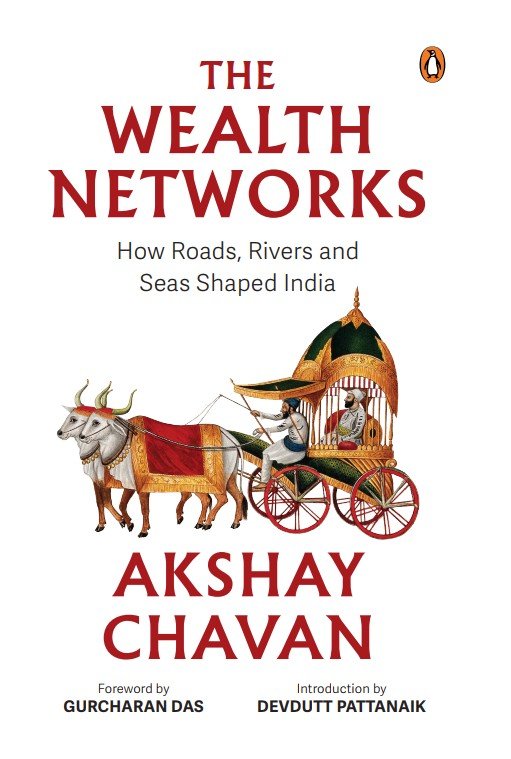
The book has been described as “not a conventional history” but “a different way of seeing.” If readers finish the book looking at India differently, what is the one idea or perspective you hope stays with them?
I hope readers take away two ideas. First, geography still matters. We often assume technology has freed us from nature, yet rivers, mountains, coastlines and climate continue to shape our lives and economies. Nature remains more influential than we often realise.
Second, prosperity comes from connection. Throughout history, regions flourished when linked to wider networks of trade, people and ideas. The same principle applies today, from relations with neighbouring countries to economic ties between Indian states.
If readers come to see India as a living network shaped by geography and connectivity, the book will have achieved its purpose.